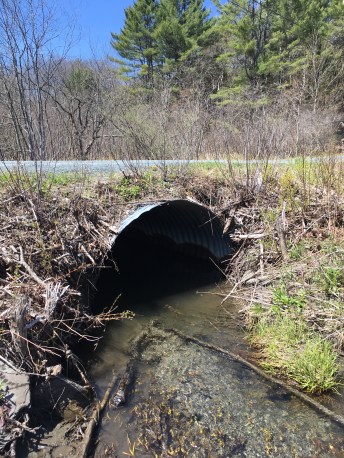
The dam place it all happened.
The J. Crew rain boots had been gifted to me by my sister. They were forest green, knee-length, gold-zippered and the perfect accessory for an afternoon at an upscale hunting club. They were fashionable, uncomfortable and unnecessary like most of the adorable gifts I received from my sister. (She gave me many a chunky bangle bracelet, which, although super cute, bobbled around my wrist like a teeter totter.) I put the boots in the back of my closet by the T. J. Maxx fuchsia-colored pumps I bought “in case I’m invited to a garden party” and next to the designer flip flops with no traction.
When the beavers arrived, the boots found a purpose. On an unseasonably warm spring day (when the grass was still short but the dandelions stood tall), I zipped the boots over my jeans. But as soon as I stepped in the stream, the boots flooded. Water seeped through the gold zipper, freezing my feet and drenching my wool socks.
I should have known a boot with a zipper wasn’t waterproof. I also should have known that my adorable pink anorak would be too warm for physical work on a humid spring afternoon. I should have known I’d need bug spray.
But wet socks, sweat, and mosquitoes would be the least of my problems that day. The bigger issue was my naivete that one afternoon at the beaver dam was all it would take.
The thing about my property is that it is mostly unbuildable, mostly unwalkable, and mostly a property tax suck. The previous owners called the ten acres “the wetlands.” I call it the “swamp.” It’s a hilly area, home to a decent, winding stream with significant marshlands. It’s not particularly interesting in terms of floral or fauna with the exception of skunk cabbage and marsh marigolds and the stream is difficult to access due to the muck.
While my house is small, my backyard is large. And over the years, I’ve learned to love it. It forms a natural barrier between my house and the paved road. It gives privacy while offering scenery. (I can’t see my neighbors and they can’t see me.) And it’s home to many a personally named woodland creature. (“Here Fishy Fishy”, the fisher cat, has been spotted numerous times in my swamp.)
The only issue is the culvert pipe. Five houses on our dirt lane depend on that pipe to move water under the shared driveway. During the spring thaw or after a week of summer rain, the water can rise immensely. I own the upside of the culvert. A neighbor owns the downside. But beavers aren’t interested in the downside.
The neighbors and I noticed the dam at the culvert after a particularly hard week of rain. The beavers hadn’t successfully jammed the pipe, but they had built a high enough dam to flood the marsh. Since the dam was on my land, I immediately contacted the Department of Fish and Wildlife. A friendly, middle-aged woman met me at the pipeline with all sorts of handouts about “Living with Beavers.” The beaver dam problem was common, she assured me. (This was obvious as the main road in town was named Beaver Meadow.) The beavers likely weren’t dangerous. (Unless they were threatened.) And I did have options.
The most obvious option wasn’t for me. Hiring a trapper seemed egregious. I didn’t want fur to get frazzled. I just wanted to be able to drive home.
“Living in harmony” with the beavers also wasn’t an option. Flooding of the road was a real threat, and it was conceivable that water could do plenty of damage to not only the driveway but the stream bank itself.
Our little road wasn’t important enough for a state-sponsored “beaver baffle” (or device to allow roads to stay maintained while protecting the beavers and wetlands.) So I decided on the third option. I would “encourage” the beavers to move elsewhere. With their beaver lodge upstream, I’d do my best not to bother the beavers, but nudge them to practice their dam-building elsewhere. No big deal.
Unfortunately, beavers weren’t interested in an honest conversation and a friendly six pack of beer. There was no way to communicate with the beavers that their dam would be best built elsewhere. I’d have to show my encouragement with a nightly game of Jenga.
After the first evening of encouraging the beavers (in those soaking wet wool socks), I learned that beaver dams are ridiculously complex. What looks like little more than a mound of pretzel sticks is a painstakingly interlocked muddle of sticks and mortar (mud). At times, pulling apart the dam felt like untangling my own hair after a convertible ride.
A few times every week, I’d pull apart pieces of the dam. I’d untangle young poplar trees (whose trunks showed beaver teeth markings). I’d pick handfuls of mud out from between the sticks. I’d move outed branches over to higher ground.
The battle was strangely fulfilling. There was no good guy, no bad guy. There was no life threatened. There was no harm wished by any involved. I was just working to protect my environment against the natural world, my opposer was trying to protect his. (Considering females often kick out their male counterparts for a while after kits are born, I imagined my enemy to be male.) It was a good ol’ fashioned struggle for territory.
In my free time, I studied the opposition. Surprisingly, there were plenty of documentaries to watch. (There’s a whole world of “beaver people” out there, folks.) I learned a lot about my furry frenemies, including that they are mostly nocturnal, that their teeth never stop growing, and that they’re monogamous. Most importantly, I learned that they live up to their reputation. They’re dam (pun intended) busy.
I could barely keep up with the dam. Whenever I would remove sticks, they’d be back the following day. Whenever I would clear a formidable section of the dam, a larger section would stand tall the next morning. For every one stick I’d pull, the following day there would be two more in its place.
I never saw a single beaver. I never heard a grunt (their vocalization of choice) or a tail slap. I never witnessed any sign of life at the beaver lodge upstream. But I spent weeks un-damming the culvert.
One late summer day, the beaver war ended. There was no sign of the beavers, no freshly chewed poplars, no muddy dam work. I checked the culvert daily for a week. But the pipes remained clear.
In the next month, I missed the little rascals. As it turned out, I had enjoyed the game of sticks. It’s rare we get to interact with nature on equal terms. It’s uncommon to wrestle the alligator, to race the cheetah, to outrun the bull. Humans have the advantage over nearly every living thing. But this beaver war made me feel useful. It made me feel alive. It made me have purpose. And it made me have to show up and try.
Life went on after the beaver war. I spent less time at the marsh and more time in my mowed backyard. Other backyard creatures (garter snakes, weasels) preoccupied my time. But with every drive, I’d pass by the remains of the dam. I’d remember the battle. And I’d hope my rodent friends were just as happy far from the culvert.
Four weeks later, I knew they were fine.
“These damn beavers,” a friend, Kurt, said as he handed me the ketchup at his backyard barbecue, “They’re going to flood that entire marsh before the end of the summer.”
Kurt lived two miles upstream from my home, with plentiful property near the valley stream. I looked down at his swamp. “You have beavers?”
“They appeared out of nowhere,” he shook his head. “I swear they put up that lodge between dinner last night and breakfast this morning.”
I couldn’t help but smile. “What are you going to do?” I asked.
“What can I do?” Kurt looked at me with a hearty laugh. “They’re beavers. You just have to let them do their thing.” He took a sip of his beer. “If there’s one thing you should know about beavers, Becky, is that you can’t outwork them.”
“Right,” I smiled to myself while I took a sip of beer. “You can’t outwork a beaver.”
I think about the beaver war anytime things become monotonous. When I don’t believe a loved one is listening. When I’m sick of mopping and re-mopping the floor. When I tire of teaching my toddler the same lesson over and over.
One day, there will be a breakthrough. The battle will end. Things will shift (for better or worse). And the war will be over.
The least we can say is that we tried. Stick by stick. Handful of mud by handful of mud. Day by day. We just have to keep going. Until the day the fight is missed.
 Becky Sabky